

Problem
Industrial AI fails in deployment, not in the lab. Most initiatives begin as bespoke Python scripts hard-coded to one camera, one line, one lighting condition so scaling to a second facility means rewriting rather than replicating, and engineering cost grows linearly with footprint. The same lack of standardization makes results irreproducible: a detection model that works at Site A floods Site B with false positives, usually because of differences in preprocessing, thresholds or alert logic that are invisible inside unstructured code. Once dozens of such scripts exist across dozens of sites, maintenance collapses under fragmentation, and each script becomes a black box owned by whichever engineer wrote it. Meanwhile the real timeline killer is integration: decades of accumulated heterogeneous infrastructure (multi-vendor PLCs, SCADA systems, legacy sensors, modern IP cameras) stitched together with fragile custom glue code. And every time an experienced engineer leaves, undocumented operational knowledge leaves with them. Underneath all five barriers sits one cause: existing tools were built for ML engineers sitting in offices, not for domain experts standing on factory floors.
Solution
Krait is an end-to-end industrial AI workflow engine built on four layers. Deployments are site-level containers that group pipelines, devices and runtime settings; Pipelines are complete ML workflows addressing a specific business objective; Nodes are atomic computation units spanning eight functional categories across four frameworks; and Hooks are typed connection interfaces, checked at design time and managing back pressure and routing at runtime. The hook system is what makes four different computational paradigms interoperate in one canvas. That architecture answers each barrier directly. Separating site-specific parameters from reusable workflow logic turns a proven pipeline into a clone-and-reparameterize operation of 1-3 days. Standardized node interfaces and versioned pipelines make behavior identical and auditable across sites. Visual pipelines are self-documenting, with logging, versioning and node-level updates. Prebuilt connectors replace glue code across six protocol families. And LLM nodes turn equipment history, maintenance logs and sensor data into a queryable organizational asset rather than tribal knowledge. All of it runs on-premise on hardware designed specifically to host Krait, not adapted from a generic industrial PC.
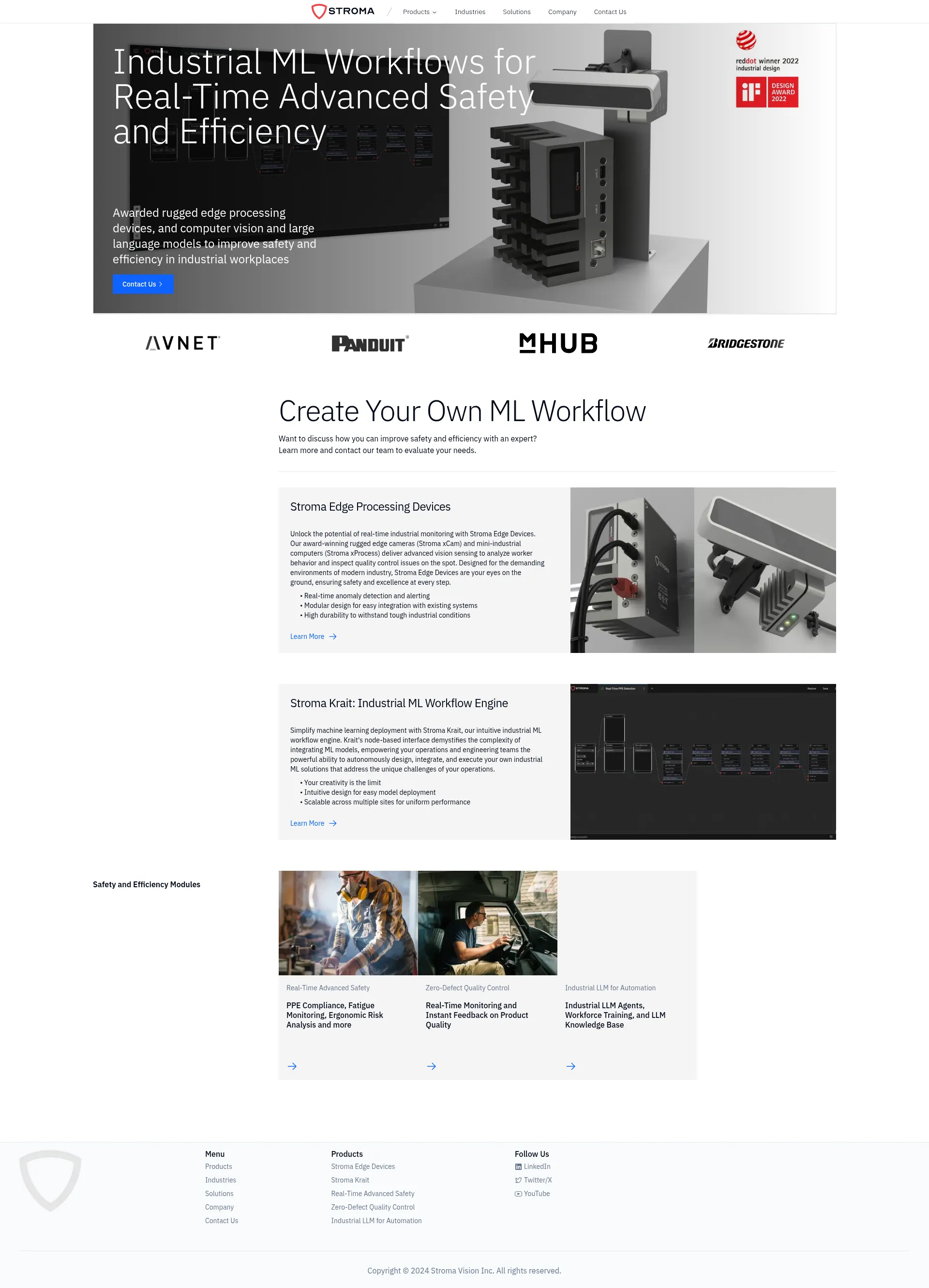
Product page snapshot
Want to connect with Stroma?
Sign up on StartupDeal to see the full profile, compare startups with AI and reach the team.